

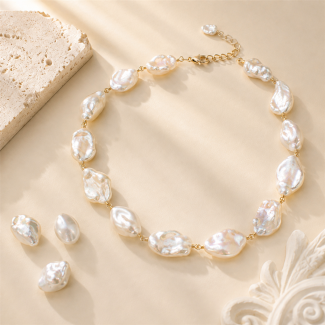
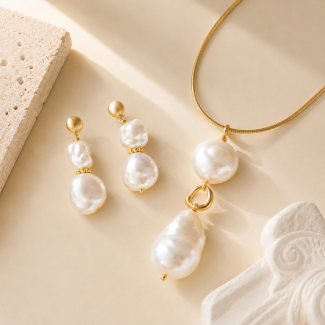
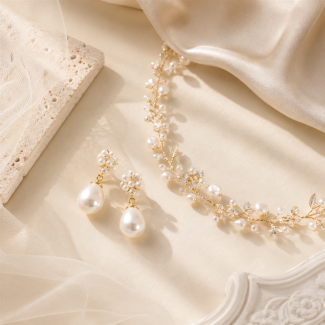
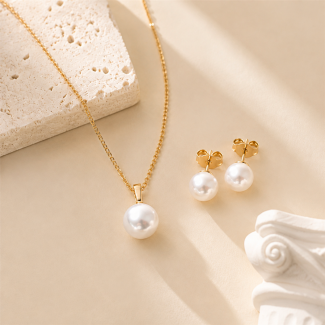
Freshwater and saltwater pearls are both real pearls when they are natural or cultured in mollusks. The main difference is the environment and mollusk in which they grow. Those differences influence typical cultivation methods, shapes, colours, sizes, availability and price—but they do not make one group automatically “better” than the other.
Most pearl jewelry sold today contains cultured pearls. Freshwater cultured pearls usually come from mussels in lakes, rivers or ponds. Saltwater cultured pearls grow in oysters in marine environments and include Akoya, Tahitian and South Sea pearls.
Freshwater vs saltwater pearls at a glance
- Growing environment: freshwater mussels versus saltwater oysters.
- Main pearl families: freshwater cultured pearls versus Akoya, Tahitian and South Sea cultured pearls.
- Typical shape range: freshwater pearls are widely available in round, oval, button and baroque forms; saltwater types vary by family and can also be round, symmetrical or baroque.
- Typical colour range: freshwater pearls often appear in white, cream, pink, peach and lavender; saltwater colours depend strongly on pearl type.
- Availability: freshwater mussels can produce multiple pearls in a cultivation cycle, helping make them broadly accessible.
- Price: saltwater types often command higher prices, but quality, size, rarity and craftsmanship matter more than environment alone.
Where each type grows
Freshwater cultured pearls grow in mussels living in freshwater environments. China leads modern production, with smaller or more specialised cultivation in Japan and elsewhere. If you want a fuller introduction to the material, learn more about freshwater pearls.
Saltwater cultured pearls grow in marine oysters. “Saltwater pearl” is an umbrella term rather than one appearance:
- Akoya cultured pearls are associated with classic white or cream colours, relatively small sizes and bright lustre.
- Tahitian cultured pearls are known for naturally dark body colours that can show green, grey, blue, purple or other overtones.
- South Sea cultured pearls are generally larger and occur mainly in white, silver and yellow-to-golden colours.
These are typical characteristics, not rigid limits. Pearls can fall outside the usual size, shape or colour range for their type.
How cultivation methods differ
Many traditional freshwater cultured pearls are tissue-nucleated. A small piece of mantle tissue is placed in the mussel, encouraging a pearl sac to form. These pearls may consist almost entirely of nacre rather than forming around a round shell bead.
Bead-nucleated freshwater cultured pearls are also increasingly common, especially among larger and rounder modern pearls. A shell bead and mantle tissue are inserted to begin the process.
Akoya, Tahitian and South Sea cultured pearls are usually bead-nucleated. The oyster deposits nacre around the bead. The thickness and quality of that nacre affect the finished pearl’s lustre and durability.
Neither method guarantees quality. A pearl should be judged by its actual lustre, surface, shape, colour, nacre quality, size and—when several pearls appear together—matching.
How their shapes compare
Freshwater cultured pearls are especially well known for variety. Round and near-round examples are available, but oval, button, drop, circled, semi-baroque and baroque forms are also common.
Saltwater pearls are not all round. Akoya cultivation often focuses on classic round shapes, while Tahitian and South Sea pearls also occur in drops, circles and baroque forms. A well-formed irregular pearl can be desirable in any category.
For the complete terminology, see our guide to understanding different pearl shapes. If you are interested specifically in free-form silhouettes, read what makes a pearl baroque.
How their colours compare
Freshwater cultured pearls offer a broad palette. Alongside white and cream, natural body colours can include pink, peach and lavender. Overtones and orient may add further depth. Some freshwater pearls are dyed, so relevant treatments should be disclosed.
Saltwater colour depends on pearl family. Akoya pearls are commonly white or cream with delicate overtones. Tahitian pearls have naturally dark body colours. South Sea pearls are known for white, silver and yellow-to-golden ranges.
Colour alone cannot identify where a pearl grew. Dyeing, coatings, lighting and photography can all affect appearance, so use the seller’s material description rather than a colour guess.
Is the lustre different?
Lustre describes the quality of light reflected from and just beneath a pearl’s surface. Akoya cultured pearls are often admired for bright, sharp reflections. South Sea pearls can show a softer, satiny glow, while freshwater and Tahitian pearls span a wide range from gentle to highly reflective.
These descriptions are tendencies, not rankings. A high-quality freshwater pearl can have excellent lustre, and a saltwater origin does not guarantee a bright surface. Compare the individual pearls in clear, neutral light.
How size changes the comparison
Different mollusks and cultivation methods produce different typical size ranges. Freshwater pearls are available from very small seed-like sizes to large bead-nucleated forms. Akoya pearls are usually more compact; Tahitian and especially South Sea pearls often occupy larger size ranges.
A larger pearl is generally rarer when other factors are comparable, but size should be considered within pearl type. A 9 mm Akoya cultured pearl and a 9 mm freshwater cultured pearl do not have the same production context.
Our pearl size guide explains how millimetres change the visual scale of earrings, necklaces and bracelets.
Why freshwater pearls are often more affordable
Freshwater mussels can produce multiple pearls at once and are cultivated in large numbers. That supply helps make attractive freshwater cultured pearls available across a wide price range.
Saltwater oysters commonly produce fewer pearls per cultivation cycle, and larger South Sea or Tahitian pearls require particular mollusks and growing conditions. These factors can increase rarity and cost.
Affordability should not be confused with low quality. Fine freshwater pearls can be round, large and highly lustrous. The price of finished jewelry also reflects metal, construction, matching, design and handwork.
Which type should you choose?
Choose according to the look, scale and budget that suit the piece—not the assumption that one environment is always superior.
- Choose freshwater cultured pearls for broad shape and colour variety, organic character and flexible pricing.
- Choose Akoya cultured pearls for a classic, often bright-lustre look.
- Choose Tahitian cultured pearls for naturally dark colours and complex overtones.
- Choose South Sea cultured pearls for larger scale and white, silver or golden tones.
Then inspect the individual pearl. Look at lustre, surface, shape, colour, nacre quality and how thoughtfully multiple pearls have been matched or intentionally mixed.
Do they need different care?
All pearl types need gentle care. Put them on after perfume, cosmetics and hairspray have dried, wipe them after wear, and store them separately from harder jewelry. Avoid ultrasonic and steam cleaners.
The construction of the piece often matters more than whether the pearl is freshwater or saltwater. Thread, adhesive, plating and other gemstones can change what cleaning method is safe. Follow our guide to caring for your pearls.
Explore more comparisons, shapes and buying guidance in our collection of pearl guides.
Frequently asked questions
Are freshwater pearls lower quality than saltwater pearls?
No. Both groups contain a range of qualities. Saltwater pearls may be rarer or more expensive in particular sizes and types, but freshwater cultured pearls can have excellent lustre, colour and shape.
Are Akoya pearls freshwater or saltwater?
Akoya cultured pearls are saltwater pearls grown in marine oysters.
Can freshwater pearls be perfectly round?
Yes. Very round freshwater cultured pearls exist, including modern bead-nucleated types, although gently irregular shapes remain widely available.
Which pearls are best for everyday jewelry?
Durability depends on nacre quality, condition and construction as well as pearl type. Choose a secure design, protect it from scratches and chemicals, and match the piece to how you plan to wear it.